

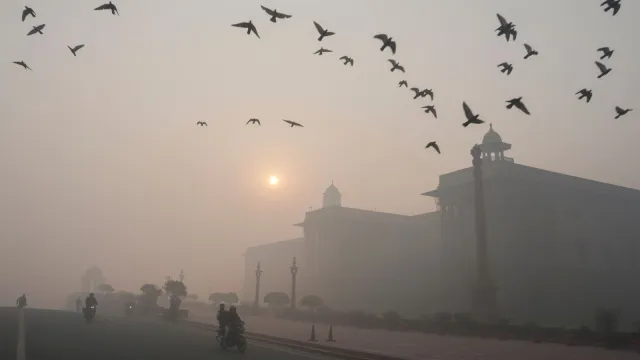
New Delhi, November 9, 2026: Delhi woke up to thick smog on Monday, a day after Diwali celebrations, as air quality deteriorated sharply across several parts of the national capital. Multiple monitoring stations recorded pollution in the severe category, raising fresh concerns about public health and the effectiveness of existing pollution-control measures.
According to Central Pollution Control Board (CPCB) data reported by The Indian Express, Jahangirpuri recorded an Air Quality Index (AQI) of 433, while Chandni Chowk registered 418. Mundka also recorded 417, indicating severe pollution in several neighbourhoods.
However, Delhi’s overall average AQI remained in the very poor category in other official morning readings, including a reading of 370 at 9 AM.
Delhi Air Quality Worsens After Diwali
The deterioration followed Diwali celebrations on Sunday, November 8, during which fireworks were set off across the city.
A thick layer of haze covered several locations on Monday morning, reducing visibility and affecting outdoor conditions.
The smog was particularly noticeable around Inderlok and other densely populated areas.
Pollution levels varied between monitoring stations, with some neighbourhoods recording substantially higher readings than the citywide average.
Delhi AQI Today: Most Polluted Areas
Early morning readings reported by The Indian Express included:
| Location | AQI | Category |
|---|---|---|
| Jahangirpuri | 433 | Severe |
| Chandni Chowk | 418 | Severe |
| Mundka | 417 | Severe |
| RK Puram | 364 | Very Poor |
| Anand Vihar | 335 | Very Poor |
| IGI Airport | 301 | Very Poor |
Note: These readings represent a reported morning snapshot on November 9. AQI values change throughout the day.
What Does Severe AQI Mean?
Under the CPCB’s National Air Quality Index system, pollution is classified into six categories.
An AQI between 301 and 400 is considered very poor, while readings between 401 and 500 fall under the severe category.
Severe air pollution can affect even healthy individuals and poses greater risks to people with respiratory or cardiovascular conditions.
Children, elderly residents and people with asthma are particularly vulnerable to prolonged exposure.
Firecracker Smoke Adds to Existing Pollution
The post-Diwali pollution spike came amid reports of fireworks being used beyond permitted hours.
The Supreme Court had allowed certified green firecrackers during specified periods on November 7 and 8.
However, green firecrackers still release particulate pollution, and Reuters reported that fireworks continued late into the night in some areas despite restrictions.
Delhi was already experiencing poor air quality before the festival because of emissions from vehicles, industrial activities, construction dust and agricultural residue burning.
Low wind speeds and cooler atmospheric conditions also contributed to the accumulation of pollutants.
GRAP Stage 3 Restrictions Remain in Force
Authorities had introduced Stage 3 restrictions under the Graded Response Action Plan (GRAP) before Diwali in anticipation of worsening pollution.
The measures include restrictions on specified construction and demolition activities, controls on certain polluting vehicles and changes to school arrangements where applicable.
The restrictions are coordinated by the Commission for Air Quality Management (CAQM) and relevant authorities across Delhi-NCR.
Despite these measures, several areas continued to report severe pollution levels on Monday.
Health Precautions for Delhi Residents
Health experts advise residents to minimise prolonged outdoor physical activity during periods of severe pollution.
People who must spend time outdoors may benefit from properly fitted particulate-filtering masks, such as N95 respirators.
Residents are also encouraged to keep indoor air as clean as reasonably possible and monitor official air-quality updates.
Anyone experiencing severe breathing difficulties or concerning symptoms should seek medical attention.
Pollution Expected to Remain a Concern
The Air Quality Early Warning System indicated that Delhi’s air quality could deteriorate further during the day and remain poor over the following days.
The outlook depends on weather conditions, emissions and the effectiveness of pollution-control measures.
Authorities continue to monitor the situation across the national capital.
Delhi Pollution: Latest November 9 Update
Delhi’s post-Diwali pollution has become a major concern as several monitoring stations recorded severe AQI readings.
Jahangirpuri registered 433, Chandni Chowk recorded 418 and Mundka reached 417 in one morning report.
Although the overall citywide reading remained very poor in several official snapshots, pollution in individual neighbourhoods was considerably worse.
The situation highlights the continuing challenge of winter air pollution in Delhi and the need for sustained action to reduce emissions throughout the year.
Sources: Central Pollution Control Board; Reuters; The Indian Express; Associated Press — November 9, 2026
Supreme News Network


Really impressed with the variety of options here. It feels very professional and secure, which is exactly what I look for. Five stars for vnvj88.