

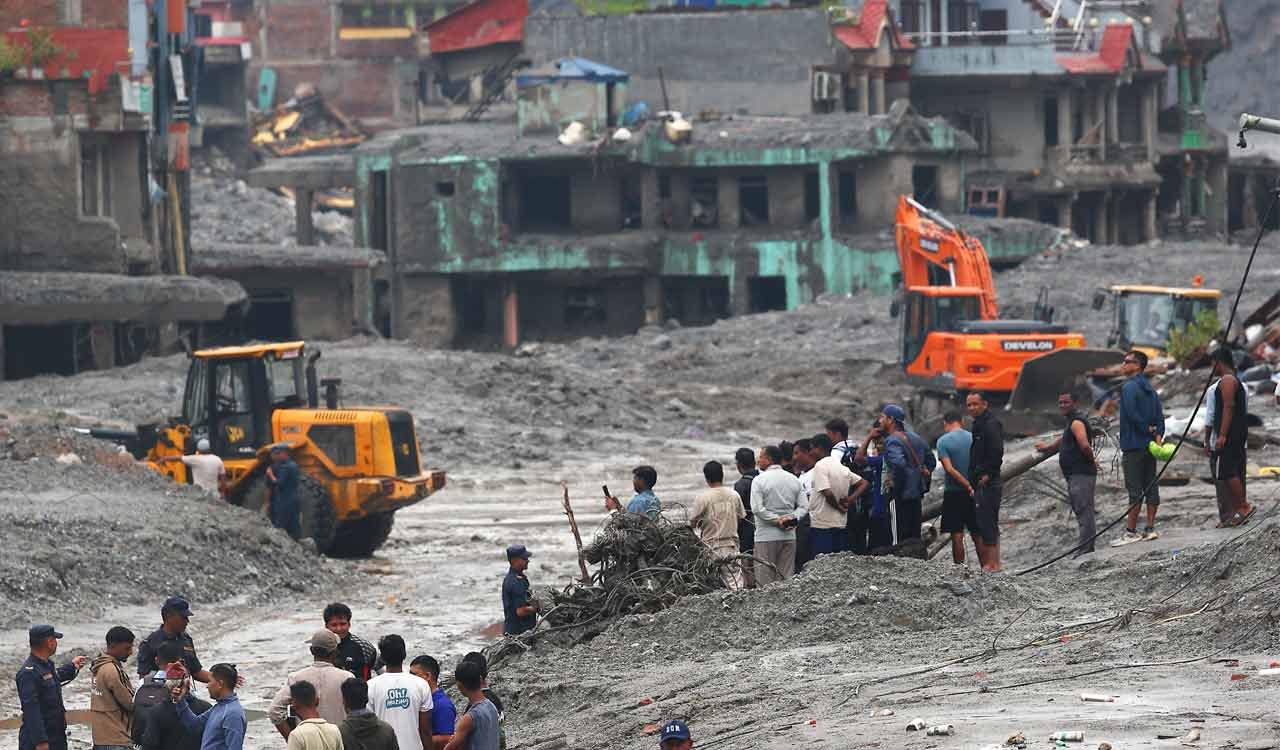
KATHMANDU, September 7: Nepal is observing a national day of mourning today for victims of the catastrophic Bhote Koshi floods, with national flags being flown at half-mast at government offices across the country and at Nepali diplomatic missions abroad.
The mourning comes on the 13th day after the August 26 disaster, while large-scale search, recovery and identification operations continue across flood-hit areas. The government had formally declared September 7 a national mourning day through a Cabinet decision earlier this month.
Flags Lowered Across Nepal and Overseas Missions
Government offices throughout Nepal and the country’s diplomatic missions overseas are flying the national flag at half-mast as a mark of respect for those who lost their lives.
September 7 also coincides with the traditional 13th and final day of Hindu mourning rituals for many families affected by the disaster.
The government has not organised major public ceremonies because rescue and search operations are still underway in the devastated areas, according to Nepal’s National Emergency Operation Centre.
Latest Official Toll Continues to Rise
The latest Nepal Police update said 1,351 bodies have been recovered, while search operations are continuing for approximately 3,992 people reported missing.
Authorities have also collected thousands of DNA samples from victims and their relatives as identification of recovered bodies remains a major challenge. More than 1,290 unidentified bodies have been listed by police as part of efforts to help families trace missing relatives.
International reports using broader figures covering the disaster zone in Nepal and across the Tibet border have placed the overall toll even higher as recovery efforts continue.
August 26 Flood Devastated Bhote Koshi Corridor
The disaster struck on August 26, when a massive surge of mud, rock and water swept through the Bhote Koshi river corridor near Nepal’s border with China’s Tibet region.
Nepal’s Ministry of Home Affairs said the flooding severely affected riverbank communities in:
- Rasuwa
- Nuwakot
- Dhading
- Gorkha
The government immediately mobilised search, rescue and emergency relief operations while beginning assessments of the extensive human and infrastructure damage.
Reuters reported that the disaster was triggered after part of a glacier broke off, sending a huge mass of debris into the river and creating a destructive flood that buried settlements, highways and other infrastructure.
Search Focuses on Hydropower Stations and Tunnels
Rescue teams are continuing intensive searches around hydropower projects and underground tunnels, where authorities believe survivors could still be trapped.
Recent rescues have renewed hopes that people may still be found alive.
In recent days, rescuers recovered:
- A Chinese national alive from a tunnel
- Two Nepali hydropower workers from another tunnel
- A Nepali woman who survived for days inside her collapsed home
Nepal Army officials said hydropower facilities remain among the priority locations for ongoing operations.
Hundreds of Hydropower Workers Still Unaccounted For
The flooding caused extensive destruction at hydropower installations in the affected region.
According to the Associated Press, rescue efforts have increasingly focused on 12 hydropower projects, where around 900 workers were reported missing, with authorities believing hundreds could have been trapped in various tunnels.
Specialised rescue personnel and technical teams from several countries, including India, China, South Korea and the United States, have been assisting operations involving tunnels, debris and damaged infrastructure.
Nearly 8,000 Police Personnel Deployed
Nepal Police has deployed approximately 7,912 personnel for search operations, relief distribution, recovery of bodies and other disaster-response activities.
Police are also:
- Moving residents away from high-risk locations
- Clearing roads blocked by debris
- Assisting with victim identification
- Coordinating with local communities and other security agencies
- Operating holding centres for displaced people
Thousands of people remain temporarily accommodated in holding centres across affected districts.
Families Demand Faster Search for Missing Relatives
Even as Nepal mourns the dead, thousands of families remain without confirmation about missing relatives.
Families gathered in Kathmandu on Monday to call on authorities to accelerate searches, particularly for people who had been working at hydropower facilities when the floods struck.
Some families whose relatives remain missing have also carried out symbolic funeral rituals without recovering their bodies, reflecting the scale of uncertainty and grief caused by the disaster.
President Visits Flood-Hit Areas
President Ram Chandra Paudel was visiting affected areas on Monday to inspect the destruction and assess the situation on the ground.
Authorities have continued rescue and recovery work despite the national mourning period, with officials saying operations will remain the priority while any possibility of finding survivors remains.
Relief and Rehabilitation Challenge Ahead
Beyond the continuing search operation, Nepal faces a major rehabilitation and reconstruction challenge.
Homes, highways, bridges, hydropower installations and other infrastructure have been damaged across the Bhote Koshi corridor.
The government has appealed for financial assistance through national disaster relief mechanisms as it works to provide emergency support, relocate affected families and eventually rebuild devastated communities.
The national mourning day therefore comes as both a tribute to the victims and a reminder that search, identification, relief and rehabilitation efforts remain far from complete.
source – Reuters / Nepal Police
Supreme News Network


Really impressed with the variety of slots here. I just hit a decent win and the withdrawal was surprisingly quick. Huge thanks to 65jilicasinologin!