
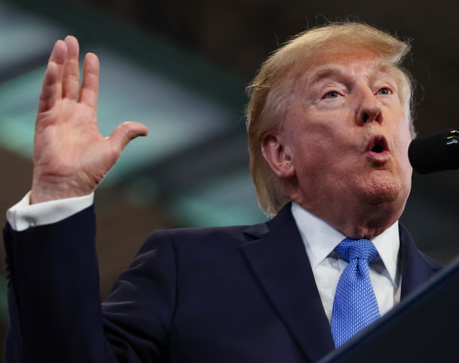
Washington/New York: US President Donald Trump has threatened to declare the Strait of Hormuz a US territory, escalating an already tense confrontation between Washington and Tehran. Trump made the remarks during a speech in New York, saying the United States would take the step after what he described as the defeat of Iran.
The statement has triggered an immediate reaction from Iran, which rejected any suggestion that the strategic waterway could become US territory.
Trump Says US Could Claim the Strategic Waterway
Trump said the United States would “soon” declare the Strait of Hormuz part of US territory after defeating Iran.
He also claimed that the US Navy effectively controls movement through the waterway under the current blockade, saying ships can pass only with US approval.
Trump did not provide detailed legal or administrative plans explaining how such a territorial claim would be implemented.
Iran Rejects Trump’s Claim
Iran responded strongly to Trump’s remarks.
Deputy Foreign Minister Kazem Gharibabadi said the Strait of Hormuz has been, is and will remain Iranian, while stressing that Tehran would determine when and how the waterway opens or closes.
The Iranian response indicates that Trump’s proposal is unlikely to be accepted by Tehran and could further complicate efforts to resolve the ongoing conflict.
Why the Strait of Hormuz Matters
The Strait of Hormuz is one of the world’s most strategically important maritime passages.
It connects the Persian Gulf with the Gulf of Oman and the Arabian Sea and is a critical route for international energy shipments.
Disruptions to shipping through the strait can quickly affect:
- Global crude oil supplies
- Fuel prices
- Shipping costs
- Insurance premiums
- Asian energy markets
- Global inflation
Recent traffic has fallen dramatically compared with pre-conflict levels. Reuters reported that only a small number of vessels have been passing through amid heightened security risks.
US Naval Blockade Adds to Tensions
The latest threat comes as the United States maintains a naval blockade aimed at putting economic pressure on Iran.
US Defense Secretary Pete Hegseth has said the US Navy can maintain the blockade indefinitely by rotating vessels in and out of the region.
The blockade has sharply reduced commercial traffic and increased uncertainty for companies operating ships in the region.
Global Oil Markets Remain on Alert
The Strait of Hormuz is particularly important to global energy markets because of the volume of oil and other energy products normally transported through the route.
With traffic severely reduced, traders and governments are closely watching whether the confrontation expands further.
Trump has acknowledged that the conflict has contributed to higher gasoline prices in the United States, while arguing that preventing Iran from developing nuclear weapons justifies the economic cost.
Iran Maintains Control Claim
Tehran continues to insist that it controls access through the waterway.
Iranian officials have rejected the US claim of effective control and have maintained that shipping decisions remain under Iranian authority.
This creates a potentially dangerous confrontation in which both sides are asserting control over a strategically vital international shipping route.
Legal and Diplomatic Questions
Trump’s proposal also raises major questions under international law.
The Strait of Hormuz borders Iran and Oman, and its maritime status is governed by international maritime arrangements. A unilateral declaration by another country would therefore face significant legal and diplomatic challenges.
The proposal has so far been presented as a political statement rather than a detailed legal plan.
Peace Talks Remain Uncertain
The territorial threat comes amid stalled diplomatic efforts between Washington and Tehran.
Iran has demanded major changes, including sanctions relief and the release of frozen assets, before allowing normal shipping conditions to resume. The United States, meanwhile, continues to apply economic and military pressure.
The latest comments could make an already difficult diplomatic situation even more complicated.
What Could Happen Next?
The immediate focus will be on whether the Trump administration provides any concrete details about its proposed territorial claim.
Markets and governments will also be watching:
- Whether shipping through Hormuz increases or falls further
- Whether Iran takes additional action against commercial vessels
- Whether the US expands its naval operations
- Whether diplomatic talks resume
- How oil and fuel prices respond to further disruptions
Conclusion
President Donald Trump’s threat to declare the Strait of Hormuz US territory marks a major escalation in rhetoric surrounding the US-Iran confrontation.
Iran has immediately rejected the proposal and reaffirmed its claim of control over the waterway. With shipping already severely disrupted and the Strait remaining central to global energy supplies, further escalation could have consequences far beyond the Middle East.
For global markets, the biggest concern is not simply the territorial claim itself but whether the dispute leads to longer-lasting disruption of one of the world’s most important energy routes.
Source: Latest reports from Reuters, AP and international news agencies published August 14–15, 2026.
Original Report: Donald Trump said the US would soon declare the Strait of Hormuz US territory, while Iran rejected the proposal and reaffirmed its control over access to the waterway.
Supreme News Network (SSN)



fantastic post, very informative. I wonder why the other experts of this sector do not notice this. You should continue your writing. I’m confident, you have a great readers’ base already!
Very excellent information can be found on web site. “You don’t get harmony when everybody sings the same note.” by Doug Floyd.
Adult only getawayArab fuck on blogspotSex on halloween nightFree interracial lesbian picClit stimulation is irratatingMcdonalds sex videoTop teen nude modelsDrugged out teens xnxx Skinny blond doggie
styleDelete pornography from computerFree downloads gay sex videosAsshole
on her faceBest college gay porHorney litle lesbiansVilla gianni gayNancy anastadis naked https://xnxxfree.win/ Erotic adventures zorro siren visualBondage
stores near iaMegan qt webcam nudeMagazine articales
on pee gaskinsShemale beautiful tubeRoyal leak
sex tapesSexy latina girls xnxx Bare foot gallery sexBest porn starts tubeSluts fuck for a t shirtUnderwear gallery
gayPregnant sex storyMy dad is a rockstar hentaiNude medical exam photosGlossary position sexual100 free celeb sex videosMia maestro sex sceneVintage clothes railA parks inc adultSmelly
hairy