

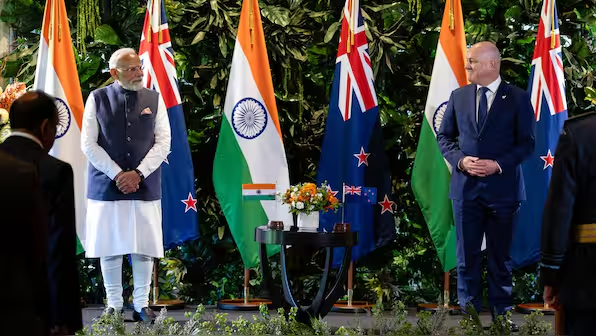
Auckland, July 11: India and New Zealand have entered a new phase in their bilateral relationship after signing 18 agreements and Memorandums of Understanding (MoUs) and formally upgrading ties to a Comprehensive Strategic Partnership. The landmark announcement was made following bilateral talks between Prime Minister Narendra Modi and New Zealand Prime Minister Christopher Luxon during PM Modi’s official visit to Auckland. The two leaders also unveiled an ambitious Roadmap to 2030, setting out a long-term framework to deepen cooperation across strategic, economic and people-to-people sectors. Reuters and official government statements described the visit as one of the most significant milestones in India–New Zealand relations in recent years.
Landmark Upgrade in Bilateral Relations
The elevation of ties to a Comprehensive Strategic Partnership reflects the growing strategic convergence between the two Indo-Pacific democracies.
Speaking after the bilateral meeting, both leaders reaffirmed their commitment to strengthening cooperation in areas of mutual interest while expanding institutional dialogue at the highest political and official levels.
Officials stated that the new partnership will provide a structured framework for long-term collaboration and regular consultations on regional and global issues.
Eighteen Agreements Signed
The two governments exchanged 18 agreements and MoUs covering a wide range of sectors aimed at expanding bilateral cooperation.
The agreements include collaboration in:
- Trade and investment
- Defence and security
- Maritime cooperation
- Digital technology
- Education and research
- Agriculture
- Renewable and clean energy
- Critical minerals
- Innovation and startups
- Cultural exchanges
Officials said the agreements are designed to generate practical outcomes while encouraging closer cooperation between government agencies, businesses, universities and research institutions.
Roadmap to 2030
A major outcome of the summit was the launch of the India–New Zealand Roadmap to 2030.
The roadmap establishes clear priorities for future cooperation, including:
- Expanding bilateral trade
- Increasing two-way investment
- Strengthening defence engagement
- Enhancing digital innovation
- Promoting climate resilience
- Improving connectivity
- Supporting education partnerships
- Deepening people-to-people relations
Both countries have agreed to regularly review progress under the roadmap through ministerial and official-level mechanisms.
Trade and Economic Cooperation
Economic partnership featured prominently during the discussions.
Both leaders emphasised the importance of expanding commercial engagement by encouraging greater investment and improving business connectivity.
Priority sectors identified for future cooperation include:
- Manufacturing
- Infrastructure
- Food processing
- Fintech
- Clean energy
- Logistics
- Advanced technologies
Business delegations from both countries also held meetings alongside the summit to explore investment opportunities.
Defence and Regional Security
India and New Zealand agreed to strengthen cooperation in defence and maritime security as part of the Comprehensive Strategic Partnership.
Areas of cooperation include:
- Defence dialogue
- Maritime domain awareness
- Counter-terrorism
- Cybersecurity
- Disaster response
- Indo-Pacific cooperation
Both leaders reaffirmed their commitment to supporting a free, open, inclusive and rules-based Indo-Pacific region.
Digital Innovation and Technology
Recognising India’s achievements in digital public infrastructure, the two countries agreed to expand collaboration in technology-driven sectors.
Future cooperation will focus on:
- Digital governance
- Artificial intelligence
- Innovation ecosystems
- Startup partnerships
- Research collaboration
- Emerging technologies
Officials believe stronger technology cooperation will create new opportunities for businesses and researchers in both countries.
Looking Ahead
Prime Minister Modi described the agreements as the beginning of a new chapter in India–New Zealand relations, while Prime Minister Luxon emphasised the importance of building a future-oriented partnership based on shared democratic values and mutual trust.
Analysts believe the Comprehensive Strategic Partnership and the Roadmap to 2030 will significantly strengthen bilateral cooperation over the coming decade while opening new opportunities in trade, investment, defence, education and technology.
The successful conclusion of the summit is expected to further reinforce India and New Zealand’s role as important partners in promoting stability, prosperity and sustainable development across the Indo-Pacific region.
Source: Ministry of External Affairs (MEA), Government of India
Original Report:
https://www.mea.gov.in/
https://www.pmindia.gov.in/
Supreme News Network