
New Delhi, November 18, 2026: The Indian Council of Medical Research (ICMR) and the Department of Health Research (DHR), under the Ministry of Health and Family Welfare, have announced three new initiatives aimed at strengthening medical research, improving disease surveillance and translating scientific evidence into effective public health policies.
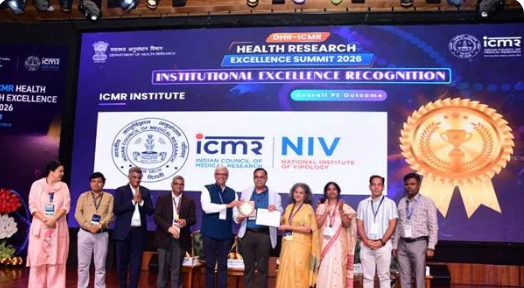
The initiatives were introduced during the third DHR-ICMR Health Research Excellence Summit, held at Bharat Mandapam in New Delhi on November 16 and 17.
The government announced details of the summit’s outcomes on November 18, highlighting significant progress in medical innovation and research collaboration.
Three New Health Research Initiatives Launched
The three initiatives focus on research-based policymaking, early detection of disease outbreaks and support for young medical researchers.
The programmes are designed to strengthen India’s healthcare research ecosystem and improve coordination between researchers, medical institutions and policymakers.
1. Research to Action Vertical
The Department of Health Research has introduced the Research to Action Vertical to help convert scientific findings into practical recommendations for government health programmes.
The initiative aims to make research evidence more accessible to policymakers and support informed decisions on public health priorities.
It will focus on translating research findings into useful materials that can guide healthcare policies and programme implementation.
2. Syndromic Surveillance Network Across 70 Laboratories
The second initiative focuses on strengthening India’s ability to detect infectious disease outbreaks at an early stage.
Under the DHR Virus Research and Diagnostic Laboratories (VRDL) Scheme, a syndromic surveillance network will connect 70 Virus Research and Diagnostic Laboratories and Infectious Disease Research and Diagnostic Laboratories.
The network aims to improve early-warning capabilities by monitoring patterns of symptoms that may indicate emerging outbreaks.
The initiative is expected to strengthen coordination between laboratories and public health authorities.
3. Dr M K Bhan Young Medical Faculty PhD Portal
The third initiative is the Dr M K Bhan Young Medical Faculty PhD Portal.
The new digital platform will provide centralised information for prospective applicants interested in pursuing doctoral research in medical and health sciences.
The portal is intended to improve access to research opportunities and support the development of future medical scientists.
Over 600 Scientists Attend Health Research Summit
The two-day summit brought together more than 600 scientists, researchers, innovators, administrators and policymakers.
Participants represented ICMR institutes, research organisations, academic institutions and government agencies.
The event provided a platform for discussing medical innovation, scientific collaboration, public health research and the translation of research findings into practical healthcare solutions.
ICMR Achieves 100 Technology Transfer Deals
One of the major achievements announced at the summit was ICMR crossing the milestone of 100 successful technology transfer agreements.
During the technology transfer ceremony, ICMR exchanged 20 licensing agreements covering eight technologies with nine Indian companies.
These agreements were facilitated under the Medical Innovations Patent Mitra initiative, launched by Union Health Minister J. P. Nadda in March 2025.
The programme aims to help convert indigenous medical research into technologies that can be developed and made available through industry partnerships.
17 Indigenous Healthcare Technologies Showcased
An innovation exhibition at the summit showcased 17 technologies developed by ICMR institutes and partner research institutions.
A separate session presented 10 technologies and eight patents, highlighting India’s growing capabilities in biomedical research.
The exhibition demonstrated efforts to connect scientific innovation with practical applications in healthcare.
ICMR Releases Antimicrobial Resistance Report
ICMR also released its Antimicrobial Resistance Annual Report and Standard Operating Procedures during the summit.
The publications bring together research findings on antimicrobial resistance and standardised laboratory procedures.
Antimicrobial resistance occurs when microorganisms develop resistance to medicines used to treat infections, making treatment more difficult.
The new publications aim to support better research practices and evidence-based public health responses.
Research Compendium Highlights 25 Success Stories
The summit also witnessed the release of an ICMR Compendium featuring 25 examples of research translated into practical outcomes.
The publication highlights how scientific discoveries can contribute to public health programmes, medical technologies and improved healthcare delivery.
It also emphasises collaboration between researchers, government organisations and industry partners.
ICMR Celebrates 115 Years of Medical Research
The summit marked 115 years of ICMR’s contribution to biomedical research in India.
Established in 1911, ICMR is one of the world’s oldest medical research organisations.
The summit included recognition of outstanding researchers and institutions across nine categories.
The top 100 school students selected through the SHINE National Competition were also recognised for their scientific thinking and interest in public health.
New Initiatives Aim to Strengthen India’s Healthcare System
The three programmes reflect efforts to improve the relationship between scientific research, disease monitoring and public health decision-making.
The Research to Action Vertical will focus on evidence-based policymaking, while the surveillance network aims to improve outbreak detection.
The new PhD portal will support aspiring medical researchers through better access to information.
Together, these initiatives could help strengthen India’s long-term healthcare research capabilities, although their effectiveness will depend on successful implementation.
Source – Press Information Bureau (PIB), Ministry of Health and Family Welfare, Indian Council of Medical Research (ICMR)
Supreme News Network