

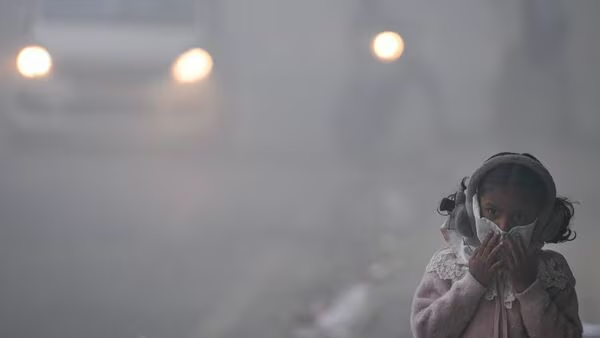
New Delhi, November 11, 2026: The Central Pollution Control Board (CPCB) has clarified why several air-quality monitoring stations in Delhi recorded missing pollution readings during Diwali celebrations, acknowledging limitations in the existing data-validation system.
In a statement issued on November 10, the pollution watchdog explained that particulate matter concentrations exceeding 1,000 micrograms per cubic metre (µg/m³) are automatically excluded from official Air Quality Index (AQI) calculations under the current framework.
The clarification follows concerns about unusually high pollution levels and differences between government data and readings displayed on private air-quality platforms.
Why Did Delhi’s AQI Monitoring Stations Show Missing Data?
According to CPCB, the National Air Quality Index system was introduced in 2015, when particulate matter analysers were calibrated to measure concentrations between 0 and 1,000 µg/m³.
Under the automated validation system, hourly readings exceeding this limit are classified as outside the designed measurement range.
These readings are subsequently excluded from calculating the relevant pollutant’s 24-hour average.
During extreme pollution episodes, such as Diwali firecracker celebrations, this can create apparent gaps in official air-quality records.
45 Monitoring Stations Reported Missing Readings
An investigation by The Indian Express found that 45 of Delhi’s 59 monitoring stations had missing hourly readings for at least one pollutant during Diwali.
Only 14 stations had complete data across the parameters examined.
The missing information included readings for PM2.5 and PM10, which are harmful particulate pollutants associated with respiratory and cardiovascular risks.
Environmental experts warned that excluding extreme pollution readings could lead to an incomplete representation of short-term pollution exposure.
Pollution Levels Crossed 4,000 µg/m³ in Some Areas
Data released by the Delhi Pollution Control Committee (DPCC) showed that particulate matter concentrations at some monitoring stations were far higher than the official validation threshold.
Reported hourly readings included:
| Location | Reported particulate concentration |
|---|---|
| Jahangirpuri | Up to 4,985 µg/m³ |
| Mundka | Up to 3,744 µg/m³ |
| JNU | Up to 3,023 µg/m³ |
| NSUT West Campus | Up to 3,008 µg/m³ |
These figures represent pollutant concentrations, not AQI scores.
The readings highlight the intensity of short-term pollution spikes recorded during and immediately after Diwali.
Why Is India’s AQI Capped at 500?
CPCB also addressed criticism surrounding the official AQI scale, which has a maximum value of 500.
The regulator explained that the 500-point ceiling is part of the National Air Quality Index methodology introduced in 2015.
Under India’s system, an AQI between 401 and 500 falls within the severe category.
CPCB argued that readings beyond this level would remain within the highest health-risk category under the current classification system.
The board also noted that different private platforms may use different averaging periods and calculation methods, resulting in variations between published AQI values.
CPCB Announces Review of Data Processing
Following criticism of the monitoring system, CPCB acknowledged that pollution-measurement technology has advanced considerably since 2015.
The regulator confirmed that internal discussions and consultations are underway regarding how readings beyond the existing system’s designed range should be processed.
However, no revised methodology or implementation date has been announced.
The review could help determine how future extreme pollution episodes are recorded and represented in official monitoring data.
Why Accurate Pollution Data Matters
Reliable air-quality information is essential for understanding pollution exposure and issuing public health advisories.
Missing readings during severe pollution episodes can create uncertainty about the full extent of short-term exposure.
Health experts recommend that residents reduce prolonged outdoor activity when pollution reaches very poor or severe levels.
Children, elderly people and individuals with existing respiratory or cardiovascular conditions may face greater health risks.
Delhi Pollution Monitoring Under Scrutiny
The latest controversy has raised questions about whether India’s existing AQI framework adequately represents exceptionally high pollution concentrations.
While CPCB has defended its methodology as a tool for communicating the health risks associated with sustained exposure, environmental experts have called for more transparent handling of extreme readings.
The regulator’s decision to review its data-processing system marks an important development following Delhi’s post-Diwali pollution spike.
Further changes will depend on the outcome of consultations and technical assessments.
Sources: Central Pollution Control Board statement, November 10, 2026; The Indian Express, Hindustan Times and Business Standard, November 11, 2026
Supreme News Network