

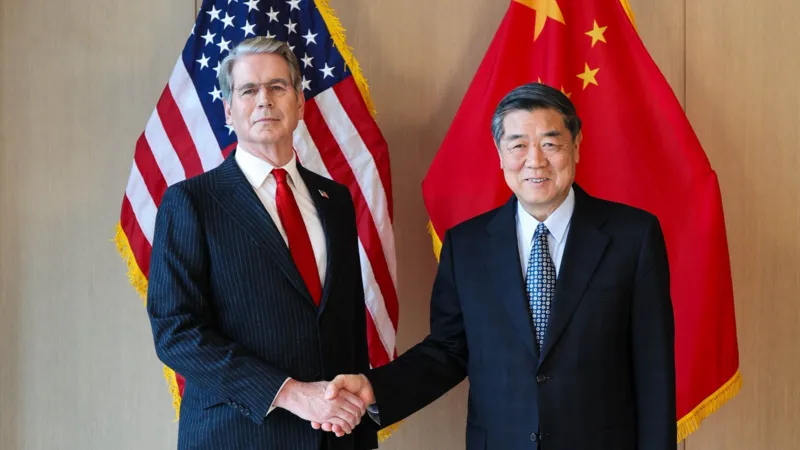
Washington, November 11, 2026: The United States and China are preparing to advance discussions on artificial intelligence safety ahead of an upcoming meeting between US President Donald Trump and Chinese President Xi Jinping, as Washington calls for greater cooperation in managing risks from advanced AI systems.
US Treasury Secretary Scott Bessent said the two countries should work together to address shared technological risks while acknowledging their continuing competition for global AI leadership.
Speaking at an event organised by the National Committee on US-China Relations in New York on November 10, Bessent outlined plans for a bilateral dialogue focused on advanced artificial intelligence, referred to by the Trump administration as superintelligence.
US and China Seek Cooperation on AI Safety
Bessent emphasised that cooperation between Washington and Beijing would not eliminate their differences over technological leadership or national security.
Instead, he argued that both countries have an interest in preventing serious incidents involving powerful artificial intelligence systems.
The proposed dialogue is intended to encourage communication between the world’s two major AI powers while preserving their ability to pursue independent technology policies.
The initiative reflects growing concerns about the potential consequences of increasingly capable AI systems.
Trump and Xi to Meet in Shenzhen on November 18–19
President Donald Trump and Chinese President Xi Jinping are expected to meet in Shenzhen during the November 18–19 Asia-Pacific Economic Cooperation leaders’ summit.
Bessent said the meeting would help advance the bilateral AI dialogue agreed upon during earlier discussions.
The leaders are also expected to address trade relations, economic cooperation and other issues affecting the two countries.
However, no new AI safety agreement has been announced ahead of the summit.
AI Safety Dialogue to Focus on Serious Risks
The planned discussions are expected to cover several important areas, including evaluating and testing advanced AI models before public release.
Officials also want to exchange information about practices that help maintain human oversight of increasingly powerful systems.
Another important objective is preventing misunderstandings between the two countries over AI-related incidents.
These discussions could provide a framework for addressing shared concerns without requiring either side to abandon its technological ambitions.
Direct Communication Channel for AI Incidents
One of the central elements of the agreement is a direct communication mechanism for reporting serious AI incidents.
The United States and China previously agreed to establish a channel that would allow officials to alert one another to significant AI-related developments or emergencies.
The mechanism is intended to reduce the risk of confusion or escalation if an advanced AI system causes a serious technical or security problem.
However, the operational details, including reporting thresholds and response procedures, have not been fully disclosed.
US and China Remain Competitors in Artificial Intelligence
Despite the proposed cooperation, Washington and Beijing remain strategic competitors in artificial intelligence.
Both countries are investing heavily in advanced models, semiconductor technology, computing infrastructure and AI applications.
The United States has maintained restrictions affecting China’s access to certain advanced technologies, while China continues developing domestic alternatives.
Bessent acknowledged that the two countries would continue competing for technological leadership.
His remarks indicate that cooperation on safety could proceed alongside broader economic and strategic disagreements.
Trade Relations Also on Agenda
The upcoming Trump–Xi meeting is expected to address economic relations as well as AI.
Bessent highlighted the importance of developing a more balanced trade relationship between the two countries.
He referred to existing discussions concerning reciprocal tariff reductions, agricultural trade and investment opportunities.
The Treasury Secretary described Washington’s broader approach as reducing economic risks without completely separating the US and Chinese economies.
Nevertheless, disagreements over trade, market access and technology restrictions remain unresolved.
Why the AI Safety Dialogue Matters
Artificial intelligence is becoming increasingly important in economic activity, cybersecurity, scientific research and national security.
As AI systems become more capable, governments face challenges involving reliability, misuse and oversight.
Communication between major AI powers could help reduce the risk of misinterpreting technical incidents or failing to respond to problems with international consequences.
However, cooperation will depend on the extent to which both governments are willing to exchange information while protecting sensitive technology and national security interests.
What Happens Next?
The November 18–19 meeting between Trump and Xi will provide an opportunity to advance the existing agreement on AI safety cooperation.
Further technical discussions are expected to clarify how the dialogue and incident-notification mechanism will operate.
For now, the two countries have outlined areas for cooperation but have not announced a new binding agreement or common AI regulatory framework.
The development highlights an attempt to manage the risks of advanced artificial intelligence while the United States and China continue competing for technological leadership.
Sources: Reuters, November 10–11, 2026; Associated Press, November 11, 2026; National Committee on US-China Relations
Supreme News Network