

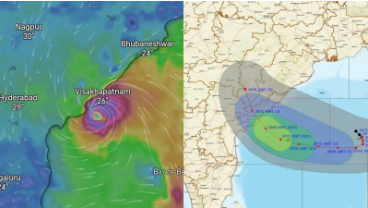
Amaravati/Bhubaneswar, October 27, 2026: Cyclone Arnab has intensified into a Very Severe Cyclonic Storm over the west-central Bay of Bengal and is moving closer to the Andhra Pradesh coast, prompting large-scale evacuations, closure of educational institutions, deployment of disaster-response teams and major disruptions to rail services.
The India Meteorological Department has forecast that Arnab will cross the Andhra Pradesh and Yanam coasts between Bapatla and Visakhapatnam, close to Yanam, during the forenoon of October 28. At landfall, maximum sustained winds are expected to reach 115–125 kmph, gusting to 140 kmph.
Arnab Intensifies Into Very Severe Cyclonic Storm
IMD said the system strengthened rapidly over the west-central Bay of Bengal after initially developing as a cyclonic storm.
By October 27, Arnab had intensified into the Very Severe Cyclonic Storm category as it continued moving west-northwestwards toward the Andhra Pradesh coast.
Landfall Expected on October 28 Morning
The current IMD track places the likely landfall zone between Bapatla and Visakhapatnam, close to Yanam.
The storm is expected to continue west-northwestwards until Tuesday evening before turning northwestwards and crossing the coast on Wednesday morning.
Wind Speeds Could Touch 140 Kmph
At the time of landfall, Arnab is forecast to carry sustained winds of 115–125 kmph.
Gusts could reach around 140 kmph, posing a significant threat to trees, electricity lines, temporary structures, weak buildings and coastal infrastructure.
Thousands Evacuated From Coastal Areas
Evacuation operations have intensified across vulnerable parts of Andhra Pradesh.
According to Reuters, nearly 50,000 people had already moved to shelters by Monday night, while evacuations continued on Tuesday. Authorities have identified several lakh residents in vulnerable areas who could require relocation depending on the cyclone’s final path.
Around 5.7 Lakh People Identified as Vulnerable
The Andhra Pradesh government has identified around 5.7 lakh people living in vulnerable areas who may need to be evacuated ahead of landfall.
The actual number shifted to shelters will depend on local risk assessments, rainfall, storm-surge warnings and the cyclone’s movement.
Pregnant Women Shifted to Health Facilities
Authorities have given special priority to pregnant women and other medically vulnerable residents.
More than 4,700 pregnant women from high-risk areas have been moved to primary health centres, community health centres and hospitals to ensure medical care remains available even if transport networks are disrupted.
Schools Shut Across Affected Andhra Districts
Educational institutions in affected Andhra Pradesh districts have been ordered closed as a precaution.
Schools and other institutions in vulnerable areas are expected to remain shut through the most dangerous period of the storm, reducing movement while evacuation and emergency operations continue.
Red Alerts Issued Across Coastal Andhra
Weather warnings have been upgraded across several coastal districts.
Authorities have issued high-level alerts as extremely heavy rainfall, destructive winds and localised flooding are expected in parts of coastal Andhra Pradesh on October 27 and 28.
Extremely Heavy Rainfall Forecast
IMD’s October 27 warning for coastal Andhra Pradesh includes extremely heavy rainfall and strong surface winds.
Similar conditions are forecast for October 28, while heavy rain, thunderstorms and squalls could continue into October 29 even after the cyclone moves inland.
Storm Surge Threatens Low-Lying Areas
A storm surge of around one to two metres above the astronomical tide is possible in vulnerable coastal areas.
The highest surge risk is expected near Kakinada and Yanam, increasing the possibility of inundation in low-lying settlements close to the coast.
Disaster Response Teams Deployed
Andhra Pradesh has deployed National Disaster Response Force and State Disaster Response Force personnel in vulnerable districts.
Seven NDRF teams and eight SDRF teams have been positioned, while additional personnel have been kept ready in areas including Visakhapatnam and NTR district.
Odisha Also Steps Up Preparations
Although the cyclone is expected to make landfall in Andhra Pradesh, southern Odisha is also preparing for severe weather.
The Odisha government has placed vulnerable districts including Ganjam, Gajapati, Rayagada, Malkangiri, Koraput and Nabarangpur on heightened alert.
Odisha Readies Around 1,700 Cyclone Shelters
Odisha has prepared approximately 1,700 cyclone shelters as part of its emergency response.
Officials are focusing particularly on low-lying, flood-prone and landslide-prone areas in southern districts likely to receive the heaviest rainfall and strongest winds.
Schools and Colleges Shut in Odisha Districts
Schools, colleges and Anganwadi centres in several southern Odisha districts have also been ordered closed during the cyclone period.
The shutdown is intended to minimise travel and allow public buildings to be used for emergency operations where required.
Fishing Suspended Along Coast
Authorities in both states have warned fishermen not to venture into the Bay of Bengal.
Odisha has prohibited fishing operations in affected coastal areas, while IMD has repeatedly warned of very rough to high sea conditions as Arnab approaches land.
Tourist Access Restricted in Vulnerable Areas
Odisha has also restricted tourist movement to hills, waterfalls and dams in several vulnerable districts.
The restrictions are intended to reduce the risk of people becoming trapped by sudden floods, landslides or rapidly rising water levels.
Rail Services Face Major Disruption
Railways have cancelled and suspended several services in advance of the cyclone.
Reuters reported that at least 12 trains had been cancelled and services on 53 southern coastal routes suspended for two days, while other reports indicated that the number of cancelled trains increased further as the storm approached.
Flights Could Also Be Affected
Air travel may face disruption at airports including Visakhapatnam and Vijayawada if winds and rainfall intensify as forecast.
Passengers have been advised to verify flight status before travelling during the cyclone period.
Rough Seas Pose Major Maritime Risk
Sea conditions off the Andhra Pradesh and Odisha coasts have already deteriorated.
IMD has forecast very rough to high seas in the affected region, with strong winds and poor visibility making marine operations dangerous.
Low-Lying Areas Face Flooding Risk
Heavy rainfall combined with storm surge could inundate low-lying coastal communities.
Urban flooding, waterlogging, damage to standing crops and disruption to road connectivity are among the major concerns for authorities.
Power and Communication Networks at Risk
Wind speeds exceeding 100 kmph can uproot trees, damage power poles and disrupt telecommunications.
Emergency teams have therefore been asked to position generators, restoration equipment and essential supplies close to high-risk areas before conditions deteriorate.
October 27–28 Remains Critical Period
The next 24 hours will be crucial as Arnab moves closer to the coast.
Weather conditions are expected to worsen progressively through October 27 before reaching their peak around landfall on October 28.
Authorities Urge Residents to Follow Official Advisories
Residents in vulnerable areas have been asked to avoid unnecessary travel, remain indoors once strong winds begin and comply with evacuation orders.
People have also been advised to keep essential medicines, drinking water, food, torches, mobile-phone power banks and important documents ready.
Cyclone Could Affect Wider Region After Landfall
Arnab’s impact will not necessarily end once the eye crosses the coast.
Heavy rainfall could continue across parts of Andhra Pradesh, Odisha and adjoining regions as the system weakens and moves inland.
Landfall Forecast Still Being Closely Monitored
Cyclone tracks can shift even within the final hours before landfall.
IMD is therefore continuing to issue frequent updates on Arnab’s location, wind intensity, rainfall and expected crossing point.
Andhra Pradesh Braces for Major Cyclone Impact
With Arnab now classified as a Very Severe Cyclonic Storm, preparations have entered their most critical stage.
Large-scale evacuations, school closures, disaster-response deployments and transport restrictions are being implemented as Andhra Pradesh and neighbouring Odisha prepare for destructive winds, extremely heavy rain and coastal flooding ahead of the expected October 28 landfall.
Source: India Meteorological Department, Reuters, The Indian Express, Hindustan Times, The New Indian Express
Supreme News Network