
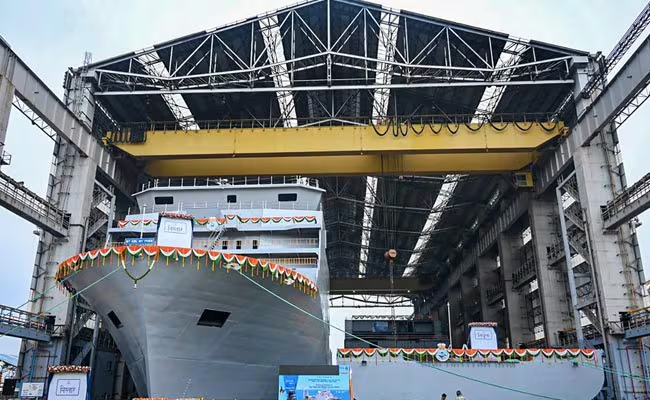
Mumbai: The Indian Navy is preparing to commission INS Nipun, its second indigenously built Diving Support Vessel (DSV), on August 31, 2026, at the Naval Dockyard in Mumbai, marking another major expansion of India’s deep-sea diving, submarine rescue and underwater intervention capabilities.
Built by Hindustan Shipyard Limited (HSL), Visakhapatnam, Nipun was formally delivered to the Indian Navy on July 30. The vessel carries nearly 75% indigenous content, reinforcing India’s push towards greater self-reliance in complex naval shipbuilding.
INS Nipun Designed for Deep-Sea Missions
INS Nipun is a highly specialised naval platform developed to conduct deep-sea diving and rescue operations.
Unlike conventional warships primarily designed for combat, Diving Support Vessels provide infrastructure, equipment and support for personnel working deep below the ocean surface.
The Ministry of Defence says Nipun is fitted with state-of-the-art diving equipment and has the capability to conduct deep-sea saturation diving.
A side diving stage allows divers to be deployed directly for underwater operations, while remotely operated vehicles can assist with diver monitoring, inspections and salvage missions.
Crucial Role in Submarine Rescue
One of INS Nipun’s most important roles will be supporting submarine rescue missions.
The ship can function as a mother ship for the Navy’s Deep Submergence Rescue Vehicle (DSRV).
A DSRV is designed to reach a submarine that has become disabled underwater and evacuate sailors trapped inside.
India operates dedicated submarine rescue systems capable of operating at significant depths, and specialised support vessels such as Nipun provide the stable platform, equipment and logistical support required to deploy them effectively.
This capability becomes increasingly important as India expands and modernises its submarine fleet.
Dynamic Positioning Keeps Ship Stable at Sea
Diving Support Vessels need to remain extremely stable while divers or rescue equipment operate below them.
The class is therefore equipped with a dynamic positioning system, which allows the vessel to maintain its position accurately even in challenging sea conditions.
According to the Department of Defence Production, India’s DSV platform has blue-water capability and can undertake sustained patrol and search-and-rescue operations.
Mission-specific equipment includes recompression chambers, a submersible decompression chamber, diving bell, remotely operated vehicles and side-scan sonar.
The vessel can also support helicopter operations.
More Than 8,500-Tonne Specialised Naval Platform
The Diving Support Vessel design is significantly larger than ordinary diving craft.
According to Ministry of Defence specifications, the platform measures approximately 119 metres in length, has a displacement of around 8,558 tonnes, and can reach a maximum speed of approximately 18 knots.
It can accommodate a complement of around 220 personnel.
Its size allows the vessel to carry extensive diving systems, medical facilities, submarine-rescue equipment and specialised underwater vehicles while remaining deployed for prolonged operations at sea.
INS Nipun Follows INS Nistar
Nipun is the second of two Diving Support Vessels built by Hindustan Shipyard Limited for the Indian Navy.
Its sister vessel, INS Nistar, was commissioned into the Navy on July 18, 2025, at Visakhapatnam.
Nistar was India’s first indigenously designed and constructed Diving Support Vessel and joined the Eastern Naval Command to support deep-sea diving and submarine-rescue operations.
With Nipun joining the fleet, the Navy will have two highly specialised indigenous vessels capable of supporting underwater rescue and intervention missions.
Stronger Capability Across India’s Seaboards
Having two Diving Support Vessels significantly improves operational flexibility.
India operates naval forces across both its eastern and western seaboards, while its submarines regularly deploy across the wider Indian Ocean Region.
A submarine emergency can occur far from a naval base, making rapid deployment of rescue equipment critical.
Dedicated Diving Support Vessels allow the Navy to position submarine-rescue assets closer to operational areas and provide a ready platform from which deep-sea rescue missions can be launched.
The ships can also perform underwater repairs, wreck investigation, salvage operations and search-and-recovery missions.
Boost for Aatmanirbhar Bharat
INS Nipun also represents an important achievement for India’s domestic shipbuilding programme.
The Ministry of Defence says the ship has nearly 75% indigenous content and was designed and built under the classification rules of the Indian Register of Shipping.
Hindustan Shipyard Limited has increasingly taken on technically complex naval projects involving submarine support, repair and specialised ship construction.
Building Diving Support Vessels domestically reduces dependence on foreign suppliers for a capability possessed by only a relatively small number of navies worldwide.
What Does ‘Nipun’ Mean?
The name Nipun comes from Sanskrit and refers to someone who is adept, capable or highly skilled in a particular discipline.
The Ministry of Defence said the name reflects the vessel’s specialised role in complex underwater operations.
Commissioning Scheduled for August 31
The formal commissioning ceremony is scheduled to take place at Mumbai’s Naval Dockyard on August 31.
Commissioning will officially bring the vessel into active naval service as INS Nipun.
Its induction will strengthen the Indian Navy’s ability to respond to submarine emergencies, conduct deep-sea diving missions and undertake specialised underwater intervention across the Indian Ocean Region.
Combined with INS Nistar and India’s existing Deep Submergence Rescue Vehicles, INS Nipun will add another critical layer to the country’s submarine safety and underwater-response infrastructure.
The commissioning also represents another significant milestone in the Navy’s continuing transition towards an increasingly indigenously designed, built and supported fleet.
Source – Ministry of Defence / The Times of India
Supreme News Network