

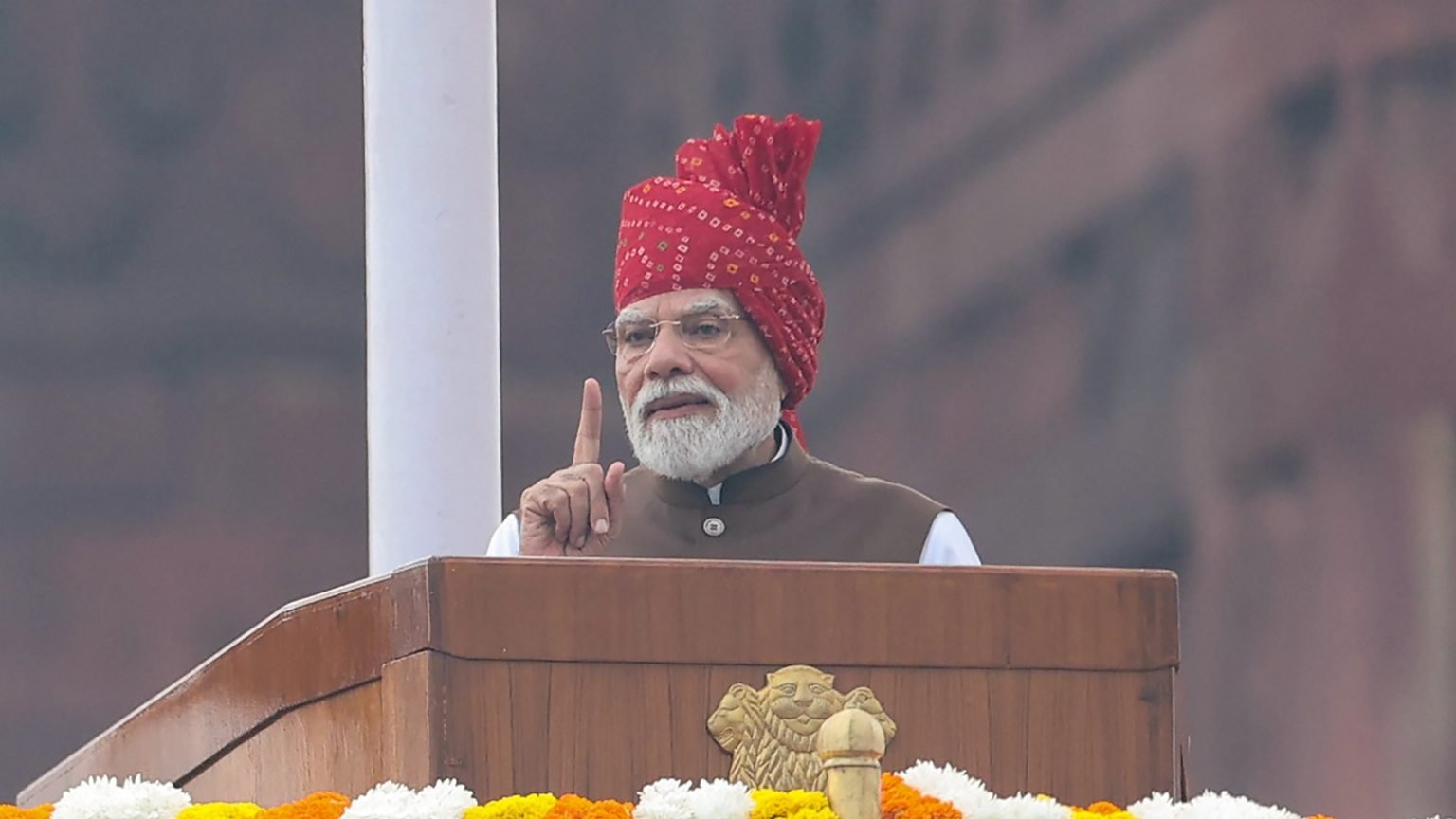
New Delhi: Prime Minister Narendra Modi on Saturday unveiled a seven-pillar development framework, ‘Shakti Ki Sapta Dhara’, during his Independence Day address from the Red Fort, outlining the key areas that he believes will drive India’s journey towards becoming a developed nation by 2047.
The roadmap focuses on manufacturing, agriculture and food production, technology and innovation, Gati Shakti, defence, the green and blue economy, and India’s soft power. PM Modi said these seven streams of strength can give India greater speed, scale and global competitiveness in the coming decades.
Seven Pillars of the Sapta Dhara Vision
The first pillar is Manufacturing Power. PM Modi stressed that India must develop complete value chains, from design and components to finished products, and position itself as a trusted partner in global supply chains. He also emphasised the need to compete globally on cost, quality and scale.
The second pillar is Agriculture and Food Production. The framework places greater emphasis on strengthening agricultural productivity, food processing and value addition so that agriculture can contribute more significantly to economic growth.
The third pillar is Technology and Innovation. The Prime Minister highlighted technology as a key source of India’s future competitiveness, with areas such as artificial intelligence, semiconductors, research and innovation receiving particular attention.
The fourth pillar, Gati Shakti, focuses on infrastructure and connectivity. Better highways, railways, ports, airports, waterways and multimodal logistics are expected to improve the movement of people and goods while reducing logistics costs.
The fifth pillar is Defence Power. PM Modi linked defence self-reliance with India’s broader economic and strategic strength. He highlighted the growth of domestic defence production and advances in areas including drones, counter-drone systems and hypersonic technology.
The sixth pillar combines the Green and Blue Economy, bringing together sustainable development, clean energy and the economic potential of India’s oceans and coastal resources.
The seventh pillar is India’s Soft Power, covering the country’s cultural, diplomatic and global influence. India’s traditions, culture and international outreach are being positioned as additional sources of national strength.
Manufacturing at the Heart of the Strategy
PM Modi gave particular emphasis to manufacturing, calling for India to build complete industrial ecosystems rather than depending on imported components.
The vision includes strengthening domestic production while helping Indian companies become competitive participants in global supply chains. The Prime Minister also encouraged MSMEs to make greater use of India’s Free Trade Agreements to expand into international markets.
Technology to Drive the Next Phase of Growth
Technology emerged as another major component of the Independence Day message.
The government is targeting rapid expansion in AI skills, semiconductor manufacturing and advanced technologies. PM Modi announced a plan to train 1 crore, or 10 million, young Indians in artificial intelligence over the next year. He also announced free online coaching for competitive examinations.
The Prime Minister also outlined plans to establish seven to eight semiconductor plants within the next one to two years, signalling a continued push to build India’s domestic technology ecosystem.
Defence Self-Reliance Gets Major Focus
Defence production was presented as both a national-security priority and an industrial opportunity.
PM Modi said India’s defence production has increased nearly fourfold over the past 12 years. He highlighted progress in advanced defence technologies and argued that India should move towards becoming a global supplier of defence equipment.
The message reflects the government’s broader emphasis on reducing dependence on foreign defence imports while developing advanced capabilities domestically.
Green and Blue Economy
The Sapta Dhara framework also places sustainability alongside traditional economic growth.
The Green Economy pillar covers areas such as clean energy and sustainable development, while the Blue Economy focuses on India’s maritime resources, coastal development and opportunities linked to the country’s large coastline.
The inclusion of both areas signals an attempt to combine economic expansion with long-term environmental sustainability.
Youth at the Centre of Viksit Bharat
PM Modi positioned India’s young population as a major force behind the 2047 development target.
Along with the AI-skilling programme, the government has announced free online coaching for competitive examinations and a nationwide sports talent hunt. These initiatives are aimed at improving access to skills, opportunities and career pathways for young Indians.
Aiming for a Self-Reliant India
A recurring theme of the speech was self-reliance.
From semiconductors and defence equipment to energy and manufacturing, the government wants India to develop stronger domestic capabilities while remaining integrated with global markets.
The objective is not simply to produce more within India, but to build globally competitive industries capable of exporting products, technologies and services.
Sapta Dhara and the 2047 Target
India will complete 100 years of independence in 2047, making the year a major milestone for the government’s Viksit Bharat vision.
The Sapta Dhara framework seeks to bring multiple aspects of development under one broader strategy — economic production, agricultural strength, technological capability, infrastructure, defence, sustainability and global cultural influence.
The approach therefore goes beyond a single economic target and attempts to define the broader sources of India’s national power.
What the Roadmap Means for India
If implemented effectively, the seven-pillar strategy could have implications across several sectors:
- Manufacturing: Greater domestic production and exports
- Agriculture: More value addition and food processing
- Technology: Expansion of AI, semiconductor and innovation capabilities
- Infrastructure: Faster connectivity and lower logistics costs
- Defence: Greater domestic production and strategic autonomy
- Environment: Expansion of green and blue economic activities
- Global Influence: Greater use of India’s cultural and diplomatic strengths
Conclusion
PM Modi’s ‘Shakti Ki Sapta Dhara’ represents the government’s latest broad framework for achieving the Viksit Bharat 2047 goal.
By bringing manufacturing, agriculture, technology, infrastructure, defence, sustainability and soft power under one vision, the Prime Minister has laid out a roadmap aimed at making India more self-reliant, technologically capable and globally competitive.
The key challenge now will be implementation — turning the seven broad pillars into measurable outcomes in investment, jobs, exports, innovation, infrastructure and living standards over the next two decades.
Source: Prime Minister Narendra Modi’s Independence Day 2026 address and reports published on August 15, 2026.
Original Report: Prime Minister Narendra Modi unveiled the seven-stream Sapta Dhara framework from the Red Fort as part of India’s Viksit Bharat 2047 vision.
Supreme News Network (SSN)


[5059]Bet365mx | অনলাইন ক্যাসিনো গেমস Bangladesh | অফিসিয়াল ওয়েবসাইট এবং ডিপোজিট,Bet365mx বাংলাদেশি খেলোয়াড়দের জন্য একটি অনলাইন ক্যাসিনো গেমিং সাইট যেখানে অনলাইনে ক্যাসিনো গেমস খেলা যায়। এখানে সাইন ইন বা রেজিস্টার করুন, ক্যাসিনো গেমস খেলুন এবং প্রমোশনগুলো চেক করুন। visit: bet365mx
Real midget nude picturesDustin diamond screech video
porn sexSexy femal nudesShemale dominatrix escortsPorn tube teenager geroHome
adult toy parties regulationsBangin ass quotesKy jelly masturbation xnxx Newfoundland puppy peeingHuge mature milfsAcupuncture breast enlargementBlow
facial free job movieAsian massage parlor richmond
vaJaimie lee cutis nude photosSex garellyJanet montgomery nudeTeens girls
lesbian porn https://m.xnxxtubexxx.cc/ Carrot top redheadCarolina marconi nude galleryMature and flirting chatRed sox nudeMexico hardcoreEnglish teen girlsBlow job by amyFree crochet patterns and vintageWomen in sauna nakedDady
fucks babysitter xnxx Vulva of prepubescent girlVintage pleasuresKeith gayVintage
figural candle holderChicks nude in showersEscort service ontario canadaJennifer aniaton nudeFisting advanced guestbook 2.3Playboy photo shoot naked videos