

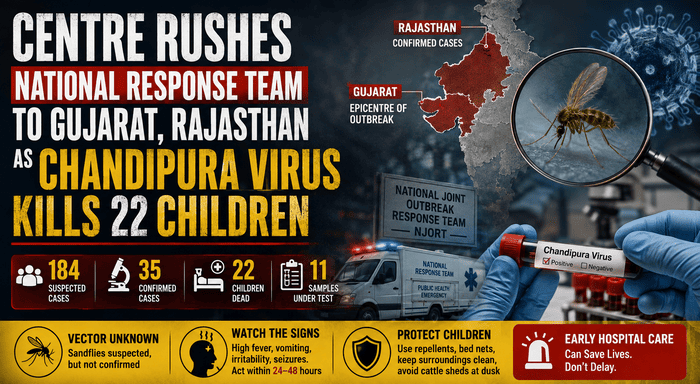
The Central Government has deployed a National Joint Outbreak Response Team (NJORT) to Gujarat and Rajasthan to strengthen surveillance and public health measures following the detection of Chandipura virus (CHPV) cases in parts of western India. The specialised team consists of experts from the National Centre for Disease Control (NCDC), the Indian Council of Medical Research (ICMR), the National Institute of Virology (NIV), and the Ministry of Health and Family Welfare.
The move is aimed at assisting state governments in containing the outbreak through rapid investigation, laboratory support, surveillance, and community awareness.
Centre Launches Coordinated Response
According to health officials, the outbreak response team has been sent to work closely with state health departments to:
- Investigate suspected cases.
- Strengthen disease surveillance.
- Support laboratory testing.
- Monitor affected districts.
- Improve case management.
- Recommend containment strategies.
Officials said the deployment is part of India’s standard rapid-response mechanism for emerging infectious disease outbreaks.
Focus on Early Detection
The NJORT will help identify possible sources of infection while strengthening surveillance at hospitals and primary healthcare centres.
Medical teams have also been instructed to ensure:
- Early diagnosis.
- Timely reporting.
- Isolation of suspected cases where necessary.
- Continuous monitoring of patients.
- Rapid sample collection for laboratory confirmation.
Public Health Advisory
The Ministry of Health has urged citizens, particularly in affected districts, to remain vigilant.
Authorities have advised people to:
- Prevent mosquito and sandfly breeding.
- Maintain proper hygiene.
- Keep surroundings clean.
- Use protective clothing and mosquito nets.
- Seek immediate medical care if children develop high fever, vomiting, seizures, or altered consciousness.
Health officials stressed that early medical intervention significantly improves patient outcomes.
Strengthened Surveillance
State governments have intensified monitoring across vulnerable districts while field teams conduct door-to-door surveys and awareness campaigns.
Laboratories have been instructed to prioritise testing of suspected Chandipura virus samples to ensure faster confirmation and response.
Officials are also closely monitoring neighbouring districts to prevent further spread.
Government Monitoring Situation
The Ministry of Health and Family Welfare stated that it is reviewing the situation daily through coordination with state governments, NCDC, ICMR, and the Integrated Disease Surveillance Programme (IDSP).
Additional medical teams and resources will be deployed if required based on evolving conditions.
Looking Ahead
The National Joint Outbreak Response Team will continue supporting Gujarat and Rajasthan over the coming days by strengthening surveillance, improving coordination, and assisting local authorities in outbreak management.
Officials expressed confidence that timely intervention, enhanced monitoring, and public cooperation will help contain the outbreak while protecting public health.
Source: Ministry of Health & Family Welfare, National Centre for Disease Control (NCDC), Indian Council of Medical Research (ICMR), and official government health briefings.
Original Report: The Centre deployed the National Joint Outbreak Response Team (NJORT) to Gujarat and Rajasthan to strengthen surveillance and response efforts against the Chandipura virus outbreak.
Supreme News Network


With havin so much content do you ever run into any issues of plagorism or copyright infringement? My blog has a lot of completely unique content I’ve either written myself or outsourced but it looks like a lot of it is popping it up all over the internet without my authorization. Do you know any solutions to help protect against content from being ripped off? I’d definitely appreciate it.
I truly enjoy reading on this internet site, it has superb posts. “A short saying oft contains much wisdom.” by Sophocles.